Crystal Scott
The Vampire Prince’s BrideCrystal Scott is a television personality and talk-show hostess who becomes the public face of an anti-shifter campaign. Her decisive role is not simply to express prejudice but to convert that prejudice into a staged media event: she abducts Ana Medina, Joseph Baker, and Senator Seth Fischer, places them before cameras in a warehouse remodeled to resemble a living room, and uses the broadcast to argue that shifters must be registered and controlled. Her rhetoric collapses when her supposed defense of humanity becomes armed violence and when Joseph forces her to confront the shifter identity she has rejected within herself.
Identity and Public Persona
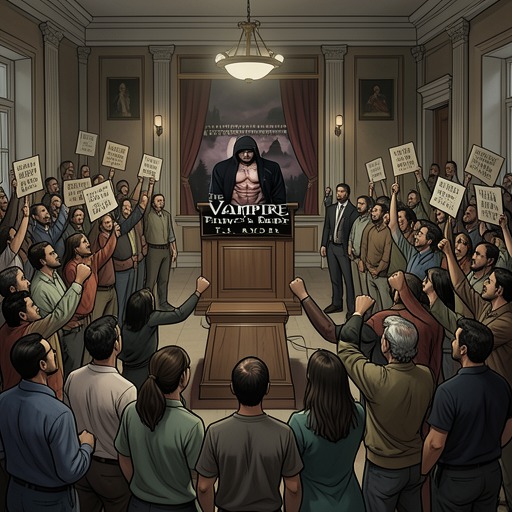
Crystal is introduced as a petite woman with black hair and blue eyes, surrounded by armed men and recognized by Ana as a television personality. She is identified as the hostess of a talk show and as the wife of an extremely wealthy man who is himself strongly anti-shifter. That social position gives Crystal access to a polished public platform, while her hatred supplies the program's emotional and ideological center. She presents herself as an authority addressing public safety, but the setting reveals the construction behind that authority: prisoners are dragged onto couches, bright filming lights surround them, and the warehouse has been transformed into a simulated living room for the cameras.
Crystal's introduction is therefore inseparable from performance. She welcomes the captives as though they were ordinary guests and says that they have joined her show, while armed guards hold them in place. The civility of the presentation makes the coercion more disturbing rather than less; the language of television hospitality masks captivity, and the familiar domestic set turns political persecution into entertainment.
Anti-Shifter Broadcast and Hostage Violence
Crystal directs her broadcast first at Seth Fischer, asking who he had to bribe to enter office and asserting that shifters are untrustworthy and vile. She then turns to Joseph, identifying him as a Bear and insisting that a shifter governed by instinct cannot be trusted to protect people. Finally, she targets Ana's relationship with Joseph, claiming that a shifter's mate bond deprives a human of meaningful choice through pheromones. Ana attempts to answer that this claim has been scientifically disproven, but Crystal's argument does not depend on evidence; it depends on presenting fear as common knowledge and the shifter body as proof of danger.
The broadcast's political demand is the restoration of the Shifter Registry. Crystal declares that the captives are stopping the registry and frames it as a necessary measure to protect humans from monsters. Her language reveals the mechanism of her ideology: she treats registration not as a restriction imposed on a minority but as a shield for an endangered majority, while defining shifters as inherently threatening before any individual action is considered.
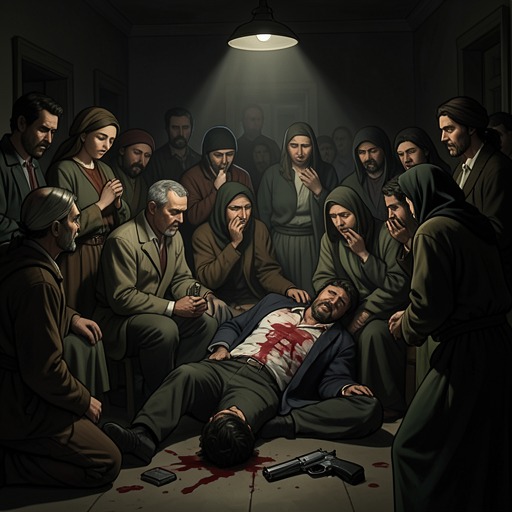
The performance escalates into direct violence when Crystal takes a handgun from one of her men and points it at Ana, Joseph, and Seth in turn. She is panting, wide-eyed, and apparently unable to regulate the fury generated by the scene she has created. She fires, and Seth is struck in the abdomen. The gunshot changes the broadcast from hateful spectacle into an attempted execution, making the contradiction between Crystal's stated concern for safety and her actual conduct impossible to ignore.
Collapse of the Protective Mask
Joseph and Crystal eventually fight in their shifter forms. As Ana reaches a forklift and considers using it to help Joseph, she sees him pin Crystal to the floor, his jaws at her throat, before he shifts back into human form. Crystal survives, but her ideological certainty fractures into sobs and self-justification. She tells Joseph that he has ruined everything and insists that she had only been trying to protect humans from beasts like them. She goes further, declaring that shifters do not deserve to walk free.
Joseph answers by redirecting the accusation toward Crystal herself. He tells her that her suffering comes from suppressing her shifter side and that she is sick because she has refused to acknowledge her Beast. Crystal rejects this interpretation with panic, calling the inner animal a demon and wishing to cut it out before it can harm anyone else. Her claim that shifters are monstrous is thus revealed as self-directed as well as political. The enemy she has displayed on television is also the part of her own identity she cannot accept.
Crystal's defeat is consequently more than a physical reversal. Her armed spectacle begins with her placing shifters in the position of dangerous captives, but it ends with her exposed as a captive of the same binary she enforces: human or beast, respectable self or demonic double, protector or threat. The violence she attributes to shifters is enacted by her own hand, while the shifter she condemns is the person Joseph insists she must acknowledge.
Relationships, Ideology, and Narrative Function
Crystal's marriage to an immensely wealthy anti-shifter man connects her media influence to elite prejudice. The available evidence does not establish that her husband directs the hostage broadcast, but it places Crystal within a powerful social environment that reinforces her message. Her show gives discrimination a respectable voice, and the broadcast demonstrates how private hostility can be amplified into public policy when joined to wealth, celebrity, armed enforcement, and political pressure.
Her relationship with Ana is aggressively instrumental. Crystal does not treat Ana as a witness with an independent account of her bond with Joseph; she recasts Ana as evidence for the claim that humans are manipulated by shifters. Likewise, Joseph is reduced to the category of Bear, and Seth is reduced to the contradiction Crystal wants to expose in a shifter senator. Each captive is stripped of personal complexity so that the broadcast can function as a simple moral display.
Crystal is best understood as a character organized around a single destructive idea, yet the breakdown after her defeat supplies a disturbing complication. She is not merely an external persecutor who fears a species from a safe distance. She has suppressed her own shifter nature so completely that she experiences it as a demon. Her public hatred and private self-rejection reinforce one another, making her both propagandist and casualty of the ideology she promotes.
Change and Narrative Significance
Crystal's plot trajectory moves from controlled public authority to exposed instability. At first, she commands the room, the cameras, the guards, and the terms of speech. She appears to possess the power to define shifters for an audience that cannot answer back. The shooting and the ensuing fight reverse that arrangement: the hostages regain physical agency, Crystal loses control of the set, and her human presentation gives way to a terrified confrontation with her own shifter identity.
The aftermath leaves Crystal defeated, cowering, and insisting that freedom itself is dangerous for beings like her. That ending does not redeem her or erase the harm she causes. Instead, it clarifies the cost of a politics built on suppression. Crystal's campaign seeks to force shifters into an official category for human protection, while she personally has attempted to sever herself from the category she fears. Her failure shows that the registry's logic is sustained not only by ignorance of others but also by the refusal to live with embodied difference in oneself.
As a narrative figure, Crystal turns the language of protection into a weapon and the television studio into a tribunal. Her scenes connect media spectacle, anti-shifter discrimination, bodily identity, and political violence. The result is a compact illustration of how persecution operates: a host labels a population dangerous, presents coercion as safety, silences testimony through staged entertainment, and finally reveals that the supposedly monstrous body is not an abstraction but a contested self.